Precision Lapidary in the Ascending Metropolis
Master physical gemstone cleavage, fretsaw blade tension, and occult awareness hazards in Fathomholm's storied subterranean workshop.
Shear stress within acceptable guild tolerance.
In Abyssal Lapidary, workshop survival hinges on three physical pillars: first, inspecting raw host rock under your jeweler's loupe to identify crystal varieties and latent fissures; second, adjusting fretsaw blade tension and arbor RPM to the specimen's Mohs hardness, preventing catastrophic fractures along natural cleavage planes; third, keeping cognitive Awareness below the critical 100 threshold while carving anomaly stones by resting at the salon counter and drinking Kamala Sahni's restorative herbal tea.
Mastering Cleavage Planes & Mechanical Shear Stress
Every gemstone harvested from the ascending crust of Fathomholm possesses unique structural crystallography. In Abyssal Lapidary, mechanical cutting is not an abstract mini-game; it is a rigid physical trial governed by Mohs hardness, fracture toughness, and cleavage geometry. Striking an ore specimen without respecting its internal atomic lattice results in catastrophic splintering, forfeiting valuable client commissions.
The Quartz Family—including Rock Crystal, Amethyst, Fine Citrine, and Smoky Quartz—exhibits a dependable Mohs hardness of 7.0 and indistinct, conchoidal fractures. These minerals represent the backbone of your early workshop economy. They tolerate minor pressure surges and facet cleanly under standard Gear 3 rotation (Standard Speed) with medium downforce.
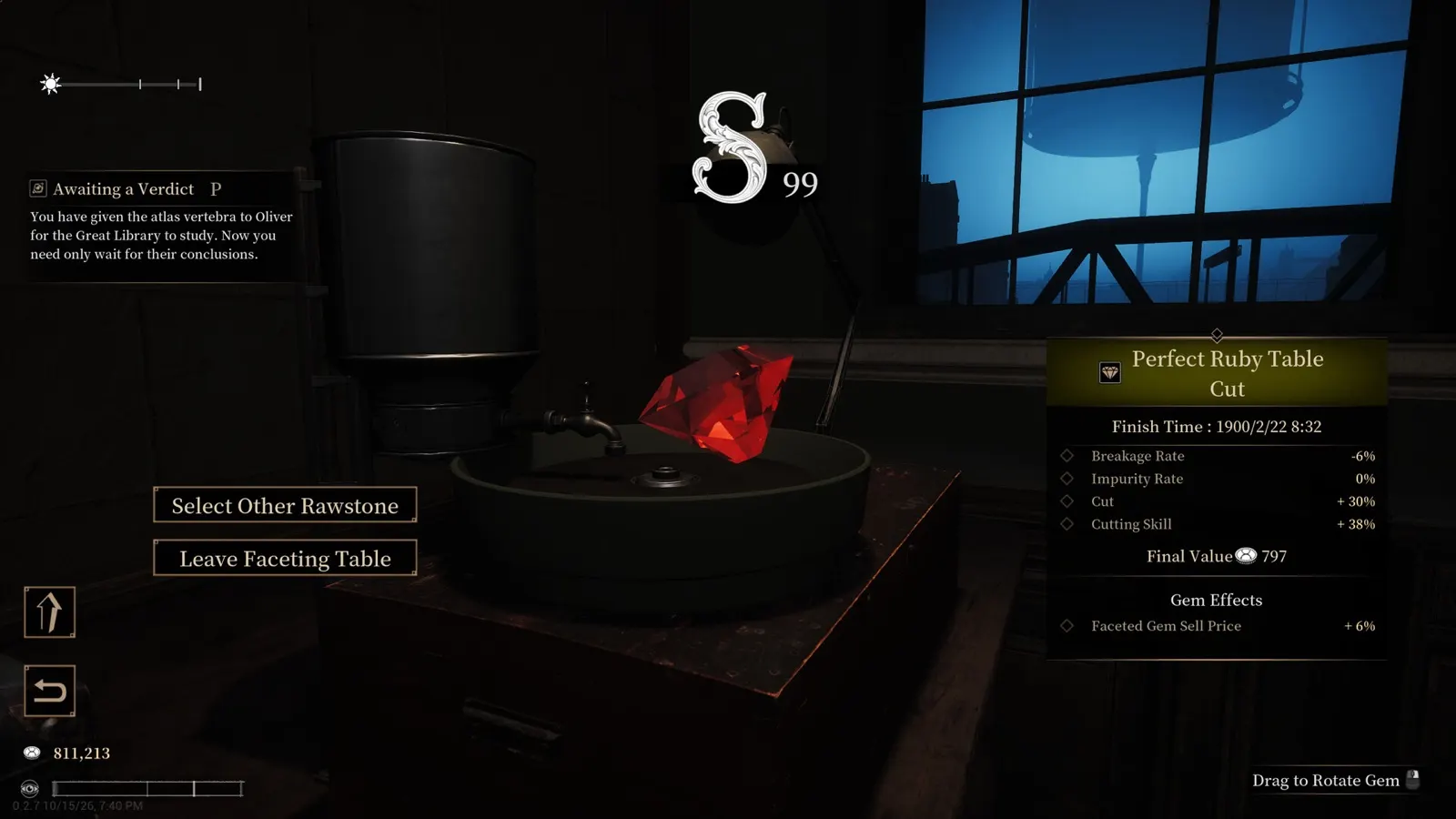
In stark contrast, precious specimens like Imperial Topaz (Mohs 8.0) feature perfect basal cleavage along the pinacoidal basal plane. If an artisan applies directional shear force parallel to this basal axis, the crystal splits cleanly in two, ruining the rough. Similarly, Pigeon's Blood Ruby and Cornflower Sapphire (Mohs 9.0) require high-grade Corundum Saw Blades or Black Diamond Blades rotating at high RPM to carve facets without blunting the teeth.
Metal Ore Shattering vs. Gemstone Faceting
The Crushing Anvil & Nodule Hammer
A fundamental rule of Fathomholm lapidary practice separates precious jewelry gemstones from metallic ores. Minerals such as Malachite (Mohs 4.0) and Fool's Gold Pyrite (Mohs 6.0)—along with raw copper, silver, and gold nodules—are never faceted on the lapidary wheel.
Instead, these metal-bearing rocks are mounted on the crushing anvil and shattered using the Nodule Sounding Hammer. Heavy mechanical strikes over a wide impact radius crack the host matrix, liberating pure base metals and precious metal nuggets necessary for expanding workbench capacity.
Machine Upgrades & Workshop Expansion
Extracted copper, tin, and gold ingots feed the workshop's capital progression. Upgrading to the Reinforced Bronze Workbench unlocks Gear 4 and Gear 5 rotation speeds, while fine silver chisels expand precision carving zones.
In our atelier upgrade runs, structural brass fittings are also required to remodel the reception salon, enabling Vermilion House to host high-paying aristocratic patrons and lucrative multi-stone commission orders.
Cognitive Awareness & Mind Overload Mitigation
The deepest geological strata beneath Fathomholm conceal minerals altered by ancient Huanyin resonance. Known collectively as Abyssal Anomalies, stones like Red Chromophage, Blue Chromophage, Hushstone, Shrift Stone, and the dreaded Stone of Erasure project potent psychic toxicity during faceting.
Each blade pass across an anomaly ore accumulates substantial Cognitive Awareness. As Awareness climbs past 50, peripheral vision blurs and the workbench crosshairs tremble. Hitting the maximum threshold of 100 triggers full Mind Overload, paralyzing the craftsman and disabling all tool handling until purged.
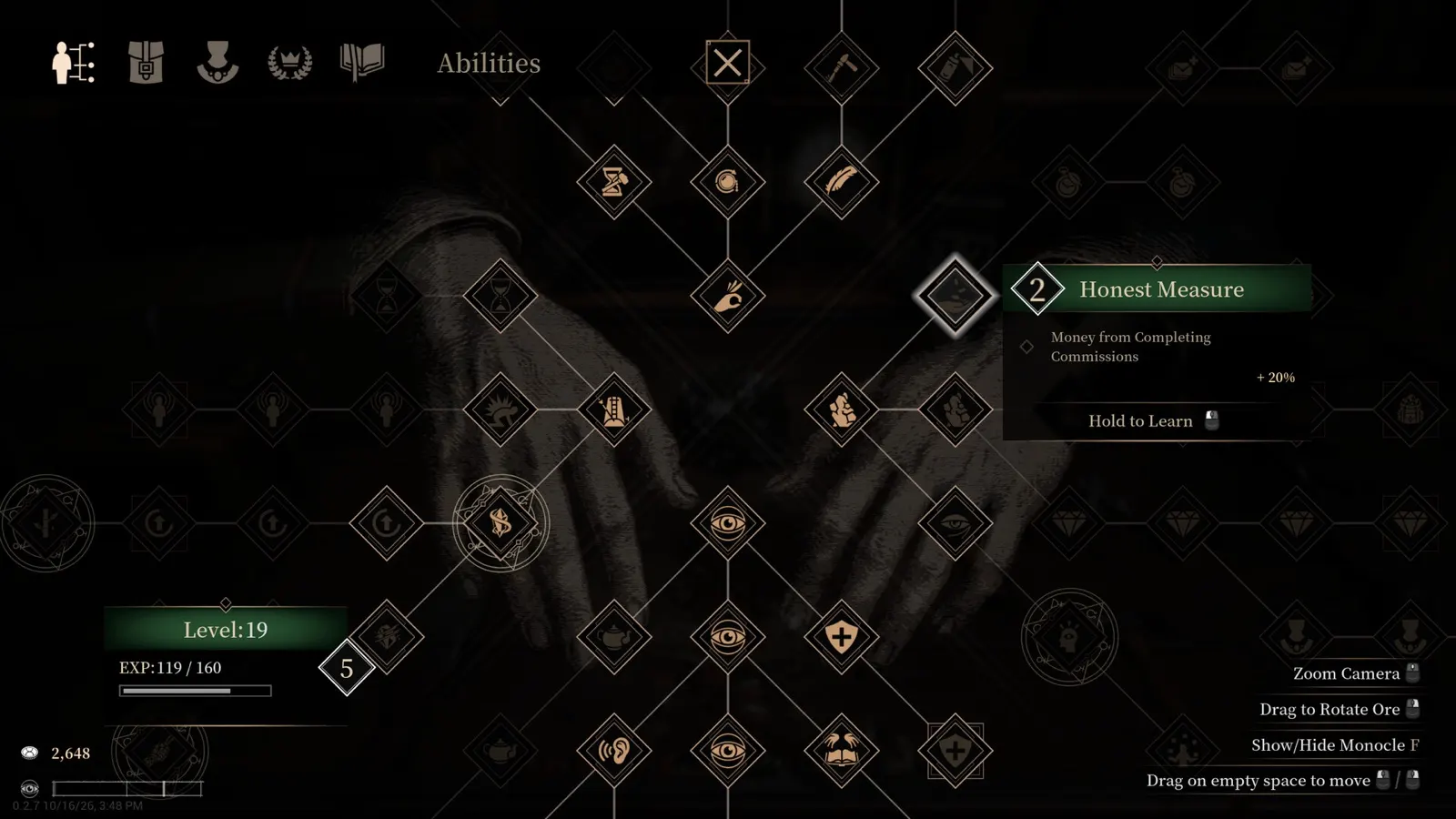
To survive, artisans must alternate cutting shifts with restorative countermeasures: resting in the salon armchairs, drinking specialized herbal tea infusions from Kamala Sahni, or investing in the Awareness Expansion I–IV guild nodes to permanently raise mental resilience.
Patrons of Fathomholm: Demands & Multipliers
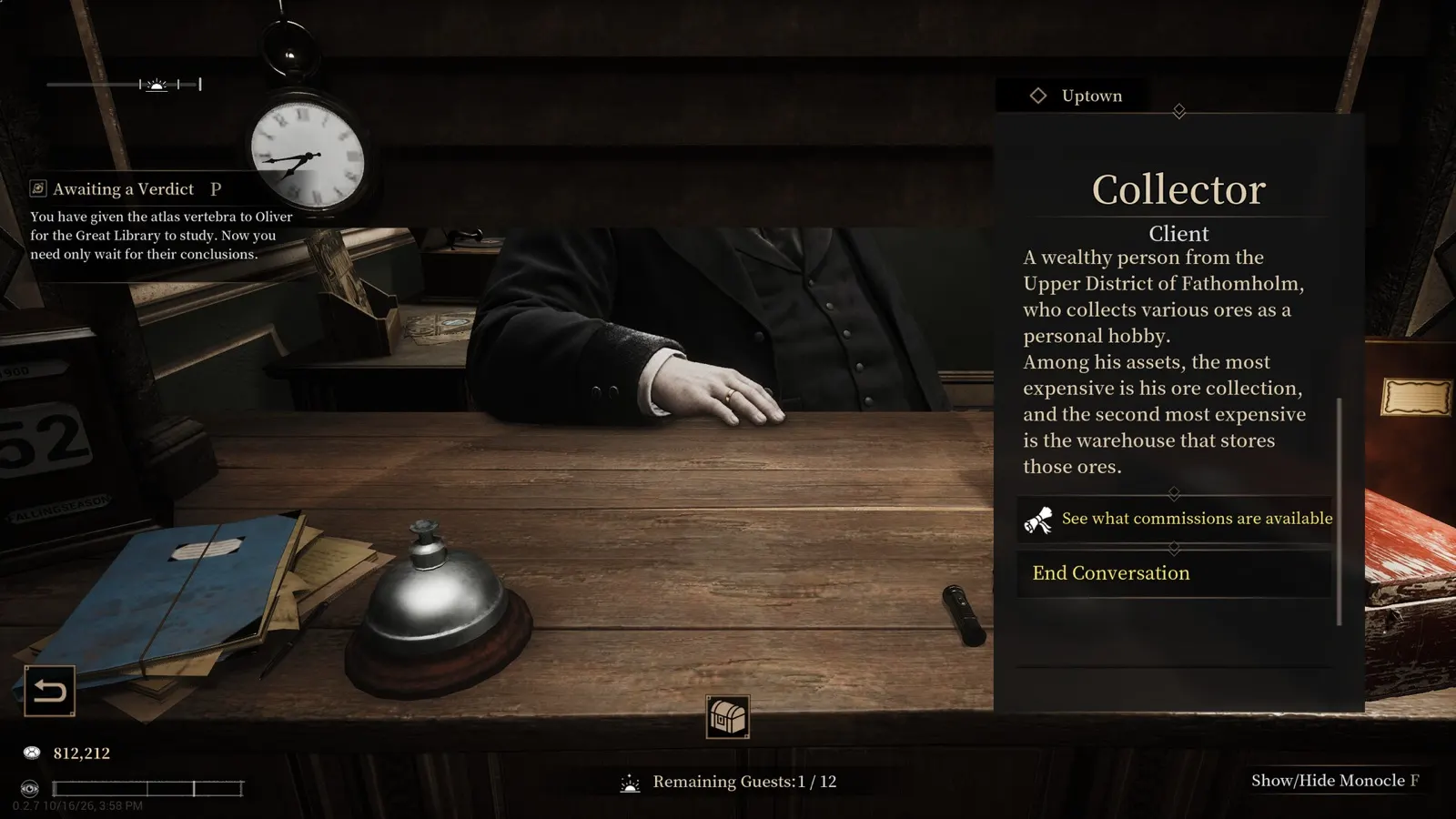
Managing Vermilion House requires negotiating with an eccentric clientele hailing from the Upper Spires, Midtown Guilds, and Lower Sump of Fathomholm. Regular patrons include "Tea Merchant" Kamala Sahni, who pays premium coin for pristine Quartz specimens; the Alchemist's Apprentice, who purchases shattered pyrite slag for catalytic crucibles; and the Great Library Pigment Master, who orders deep-blue Lapis Lazuli to grind into permanent archival ink.
Aristocratic collectors such as the Lady of Means demand complex step-cut geometries like Emerald Cut III on flawless Padparadscha and Beryl roughs, rewarding zero-defect perfection with massive monetary bonuses. Matching each patron's bespoke taste builds guild standing and unlocks exclusive tool blueprints.
Frequently Answered Dockets
Essential operational knowledge recorded by the master craftsmen of Vermilion House.
What is the core gameplay loop of Abyssal Lapidary?
Players operate Vermilion House in the subterranean city of Fathomholm: examining rough ores under a jeweler's loupe, chipping matrix with chisels, faceting fine gems on the lathe, satisfying client commissions, and balancing cognitive Awareness toxicity.
How do you purge Cognitive Awareness?
Awareness accumulated from anomaly stones like Chromophage and Shrift Stone can be dispelled by resting in the reception lounge, purchasing soothing tea blends from Kamala Sahni, or forging Awareness Expansion workshop upgrades.
Can metal ores like Malachite be faceted?
No. Metal ores such as Malachite and Fool's Gold Pyrite are struck directly on the anvil with sounding hammers to extract base and precious metal nuggets, which are then used to build workbench and tool upgrades.